
This week, the trial of six young activists who attempted to disarm Israeli weapons in a British arms factory draws to a close. Thirty years ago this month, four women undertook a similar action; in both cases, the defendants argued that their actions were legal attempts to prevent genocide. The political climate – and legal rights – have deteriorated significantly between the two actions: but the state is more afraid now than ever.
Originally published in Counterpunch + , 25th January 2026
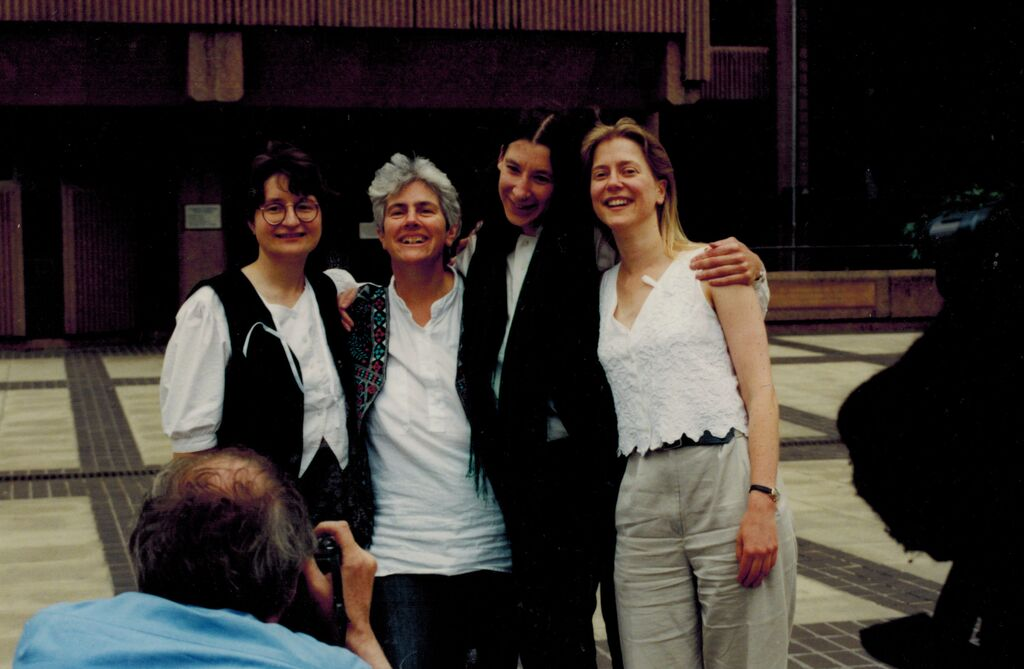
Thirty years ago this month, on January 29th 1996, three women broke into a British arms factory near Liverpool and set about disarming a Hawk fighter jet, built by British Aerospace for use by Indonesia in their genocidal war against East Timor. Hammering on the wings, fuselage, nosecone and control panel, they caused somewhere between £500,000 and £1.7million of damage to the plane and delayed the plane’s delivery to Indonesia by an undisclosed amount of time.
The action was first conceived at a ‘Ploughshares’ workshop at a peace camp in 1995. The Ploughshares movement takes inspiration from the biblical injunction to ‘turn swords into ploughshares’ and uses nonviolent direct action to disarm the weapons of war. The first Ploughshares action took place in the US in 1980, when eight people hammered on the nosecones of nuclear warheads at a General Electric factory in Pennsylvania; ten years later, Stephen Hancock and Mike Hutchinson inaugurated the movement’s presence in Britain when they snuck into USAF Upper Heyford in Oxfordshire intending to disable warplanes. At the workshop in 1995, several of the female participants agreed it would be great for such an action to be undertaken specifically by a group of women.
For the next ten months, Andrea Needham, Lotta Kronlid, Angie Zelter, Jo Wilson and their support group comprising six more women spent an intensive weekend each month in preparation for what they were about to do. Their target was to be one of the 24 Hawk fighter jets British Aerospace were building for Indonesia, which were being used to bomb Timorese villages, contributing to an estimated death toll of one third of the population since the occupation began twenty years earlier. General Suharto, head of the Indonesian state and military, had taken power in 1965 in a coup facilitated by the US and Britain, which saw hundreds of thousands of suspected communists executed using hit lists provided by western intelligence services. He was their man, and they were determined to use him to cull a resistant population threatening neocolonial designs in the region. John Pilger’s 1994 film, Death of a Nation, with its footage of the 1991 Santa Cruz massacre (filmed and smuggled out of the country by Max Stahl), had highlighted Suharto’s crimes for the first time to many in Britain – including the Ploughshares women.
At their monthly meetings, the women discussed everything from their fears about prison life, how they would respond to violent security guards, and how to deal with the media; to philosophical discussions around militarism, patriarchy and authority – not to mention the detailed planning of the action itself. As the agreed date approached, gruelling reconnaissance operations were undertaken, involving lying on frozen ground overlooking the factory from dawn til dusk until they were finally able to ascertain which hangar was housing the Hawks. At the last meeting of the full group, meditations were conducted on the themes of fear, violence, and despair, with each of them writing down what these meant to them, before burning the paper. Another was held on the theme of hope, whilst holding a handful of seeds which were then mixed with the ash from the burnt papers to sprinkle at the scene, and which gave the name to the action: Seeds of Hope Ploughshares. Then the hammers, some of them hand carved by members of the group, were given a blessing – and on the night of January 29th, three of the women headed out to BAe Warton in Lancashire.
Several things went wrong. Someone was out late working on their boat in the usually deserted boatyard they had to cross on the way to the factory, forcing them to climb up an almost vertical bank and over a barbed wire fence, their heavy bags full of hammers and iron crowbars. When they got to the site, the lights on the site were unexpectedly on, unlike every other Sunday they had been there. They decided to proceed regardless – any delay would mean the Hawks might have already been shipped to Indonesia. Then, at the hangar itself, after smashing the glass window of the fire escape, they couldn’t find the bar on the other side to get it open. Jo ran around the building and managed to find another entrance on the folding metal shutters, which between them they managed to crowbar open. They were in.
In her brilliant book on the action, The Hammer Blow, Andrea Needham recounted that “One of the beautiful things about Ploughshares actions is that anyone can do them. You don’t need to be a technical genius or an engineer, you don’t need to be physically strong, you don’t need any expensive equipment or special skills. All you need is a hammer and a functioning arm. We each had both of those things. We started hammering.”
Working quickly, and expecting to be discovered any moment, they focused on the nosecone and control panel, where they knew they could do the maximum damage in the least time. They scattered their seeds, hung a banner on the plane, and left a video and booklet outlining the situation in East Timor in the cockpit, hoping they’d be seen by the British Aerospace management, the police – and ultimately the jury.
In the end, they had far more time than they’d expected. They could probably, in fact, have damaged all of the Tornadoes and Hawks in the hangar, several of which were bound for Saudi Arabia, another neocolonial client state charged with repressing resistant populations on the west’s behalf. But they restricted themself to the plane bound for Indonesia, “to keep the issue clear.” Several times a security buggy drove by the hangar but failed to spot them, even when they were jumping up and down to attract their attention. Getting caught – in order to explain themselves and be accountable for their actions – was always part of the plan, but “the one possibility we hadn’t discussed was that of not being able to let British Aerospace know we were there.” In the end, they decided to call the press from a phone they found in an office, so that the company would be alerted to their presence when they were called for a comment. They also took the opportunity to call their comrade Angie and Lotta’s relatives in Sweden, and were on the phone to John Pilger when the security finally arrived.
Like the Filton 24 on trial this week, they were denied bail and remanded in custody, facing prison sentences of up to ten years if found guilty. And like the Palestine Action prisoners currently on hunger strike, they found the diktat of the prison regime – capricious and arbitrary at the best of times – even more vindictive than usual due to the political nature of their charges. Locked inside for weeks at a time – despite the statutory right to an hour’s outdoor exercise per day – they were then barred from running when they finally got out; and even barred from walking round the perimeter, supposedly on the grounds that they might pass things to the women on the hospital wing as they passed by.
They were then barred from being moved to the usual wing for prisoners with ‘good behaviour’ – where they would have had a chance to work on their defence preparation together – as, the governor explained, the Home Office had claimed they represented a “security risk.” The governor had already told Lotta they were worried the women might attempt to organise a ‘sit-down protest’ amongst their fellow prisoners, but did eventually let slip the real reason for the supposed ‘threat’ posed by the women: “You’ve embarrassed the government once,” she told them, “and we don’t want to give you the opportunity to do it again.” They were also barred from attending prison education and art classes.
The 29 Palestine Action prisoners currently on remand in British jails (the Filton 24 and the Brize Norton 5) have also been deemed a security risk, with some even reclassified as ‘terrorists’ following the government’s banning of Palestine Action last summer. Amu Gib, of the Brize Norton 5, was barred from art classes after they embroidered ‘Free Palestine’ onto a cushion they were making, and others have apparently been barred from socialising, going to gym, and receiving mail. Amu explained recently that this arbitrary abuse of their rights was a significant part of the reason for the current hunger strike.
In July 1996, after nearly six months on remand, the women’s trial began. They wanted to represent themselves, but had decided it would be useful to have a barrister in the room, so in the end Jo agreed to be represented by Vera Baird whilst Lotta, Andrea and Angie represented themselves. It turned out to be an excellent compromise. On a psychological level, seeing the women seated behind a desk taking notes rather than only in the dock – effectively in the role of barristers as much as defendants for much of the trial – may well have given them a certain legitimacy and respectability in the subconscious mind of the jury. But having a trained barrister able to take on the judge over points of law also turned out to be extremely helpful.
They had been charged under the Criminal Damage Act 1971, which makes it an offence to destroy or damage property “without lawful excuse”. And, as Andrea put it, “on that three word rider hung our whole case.” Their excuse was that of using reasonable force to prevent a crime, as allowed under section 3 of the Criminal Law Act 1967.
Early on in the trial, three key decisions were made that proved crucial for their case.
Firstly, after a long battle by their tenacious barrister, the judge allowed them to bring in expert witnesses to demonstrate that British-made Hawk fighter jets were indeed being used in East Timor to commit war crimes. The judge had initially denied their request out of hand. The ‘reasonable force’ defence technically rests on whether the defendant genuinely believes that a crime is taking place. The prosecution argued that, as the Crown had conceded that the defendants did genuinely believe this, there was no need for them to prove that a crime actually was occurring in East Timor. But Vera challenged this, arguing that the defence still needed to prove that the belief that Hawks were carrying out war crimes in East Timor was a reasonable one. She pointed out that the prosecution, like British Aerospace themselves, had consistently referred to the Hawks as ‘trainer’ jets, downplaying their lethal capacity, and thereby attempting to sow in the jury’s minds that it was unreasonable to believe they were being used to commit war crimes. Eventually the judge relented, on the condition that the state would not be expected to pay for witnesses to be flown over from East Timor. This decision allowed the women to completely turn the tables and use the court to put British Aerospace and the British government on trial for complicity in genocide. One witness after another – including esteemed documentary maker John Pilger, Timorese resistance leader Jose Ramos Horta, and former political prisoner and founder of the Indonesian human rights campaign group TAPOL Carmel Budiardjo – all testified that Hawk jets were indeed being used to terrorise the Timorese people. “It would be almost impossible for the Indonesians to maintain their occupation without the use of ground-attack planes,” explained Budiardjo, adding that the cancellation of the Hawk deal would “lift an enormous burden” from the Timorese.
Secondly, the judge dismissed the prosecution’s attempts to prevent the jury from seeing the video the women had made explaining their actions. The video provided crucial context as to what was happening in East Timor, including first hand accounts of the genocide, as well as excerpts from British Aerospace’s own advertising materials for the Hawk, proudly proclaiming its attack capabilities: the very capabilities which the prosecution had desperately been trying to hide from the court. This video had completely changed the attitude of the magistrates when it had been shown to them at the women’s initial committal hearing, and the defendants hoped it would do the same for the jury.
Finally, the judge allowed each member of the jury to read a copy of the booklet produced by the women. The prosecution claimed it was propaganda and the jury should not be allowed to see it, but the judge ruled they were “sensible enough” to view it if they wished. Allowing the jury to read and view first hand accounts of what was going on in East Timor brought home the gravity of what was at stake – and leaving the materials at the site, ensuring they were seized as evidence, was a genius act on the part of the women.
The prosecution case was weak from the start. Conceding that the women genuinely believed that Hawk jets were facilitating war crimes in East Timor, they were reduced to arguing that stopping these crimes wasn’t their real motivation. They knew, the prosecution claimed, that the Hawks would be sent to Indonesia anyway, and therefore that their actions would not be preventing the crimes they claimed to be concerned about. Their true aim, they claimed, was not to prevent a crime, but to gain publicity for the cause. The prosecution case was fundamentally weakened, however, when British Aerospace themselves admitted that the Hawk’s delivery to Indonesia had been delayed by the damage the women had inflicted on it.
Throughout the trial, the defendants were never defensive, but always on the frontfoot, knowing they had not only morality and justice, but law, on their side. They utterly rejected the state’s attempts to project its own guilt onto them, throwing it back where it belonged every time:
“Do you not accept that this was a very, very irresponsible thing to do?,” the prosecution barrister asked Jo Wilson. “Not at all,” she replied, “What is irresponsible is selling weapons to a regime which Amnesty International has described as casual about mass murder.”
“Do you think it was right to take the law into your own hands and go and attack someone else’s property?,” he asked Lotta. “I think the people who have taken the law into their hands are British Aerospace and the British government”, she replied. “They are blatantly breaching the Genocide Act. I’m not breaking the law, I’m upholding it.”
The jury agreed. After a tense four hour wait, the foreman announced that the four defendants had been found not guilty on all charges.
Indonesian foreign minister Ali Atlas had once described East Timor as an annoyance, “like a pebble in the shoe,” before admitting years later that the pebble had become “a veritable boulder.” Three years after the women’s break-in at RAF Warton, the Indonesian military was forced out of East Timor by a combination of popular resistance and international pressure; Andrea later said she believed that “what we did contributed in some small way to the goal of turning the pebble of East Timor into a boulder.”
Since then, much has changed – but not everything. Britain is still arming genocide, and activists are still doing all they can to sabotage the weapons of war. Palestine Action has led the recent wave of nonviolent direct action against the manufacture of weapons for use in Israel’s attempts to annihilate the resistant people of Gaza, co-ordinating a incredible 400 actions against Elbit, an Israeli arms company with multiple factories in Britain, and the chief supplier of weapons to the IDF. Their tenacity – especially after one of their actions shifted focus to the complicity of the RAF itself – resulted in the group being banned last August, the first time an entirely nonviolent protest group had been proscribed as a ‘terrorist organisation.’ Supporting the group now carries a sentence of up to fourteen years.
And an obscure House of Lords ruling in 2005 has been seized on by British courts recently to prevent a repeat of what happened in Liverpool Crown Court in 1996. Lord Hoffman, in an aside, claimed that, in a democratic state, no use of force can ever be reasonable to prevent crimes committed by the government, as the only reasonable way to challenge the government is through parliament or the courts. Therefore, he concluded, “evidence to support the opinions of the protesters as to the legality of the acts in question is irrelevant and inadmissible.” In the Filton 24 case being heard this week, the result is that, whilst the quadcopters targeted by the activists have been responsible for some of the most heinous war crimes of the whole Gaza war – as testified by respected surgeon Nizam Mamode in Parliament – none of this evidence has been allowed in front of the jury. Using the court to put UK complicity in genocide on trial, as the Ploughshares women did in 1996, has been rendered far more difficult now than it was then.
There were other factors in favour of the not guilty verdict in 1996. Liverpool was a fortuitous place for the trial to be held, with a long tradition of anti-imperialism and scepticism towards authority due to its large Irish heritage population and proud working class identity – not to mention being the victim of a massive state and media onslaught to justify the unlawful killing of 97 Liverpool fans at a football match in the 1989 Hillsborough disaster. Had the trial been held in Preston – the nearest court to where the action was held, where a significant proportion of the population work for British Aerospace, and where the local press had been unremittingly hostile to the action – the result may perhaps have been different.
Furthermore, unlike Palestine Action today, there was no insinuation made that the Ploughshares women were terrorists; portraying them as such would likely have backfired on the prosecution, making them appear ridiculous and even unhinged. The Filton activists, however, were initially arrested for terrorism offences; their supporters and families were rounded up in dawn raids by masked police with automatic rifles; their group was banned as a terrorist organisation; and their trial is being held in Woolwich Crown Court, famous for its terrorism trials. Although not charged in the end with any terrorism offences, the state has labelled their crimes as having a ‘terrorism link,’ meaning the judge is able to arbitrarily increase their sentences beyond what would normally be considered acceptable should they be found guilty. The result of all of this is to create a context and atmosphere almost entirely absent in the Seeds of Hope trial, in which the defendants are a-priori demonised as terrorists and traitors.
Finally, it cannot be ignored that the Seeds of Hope action chimed more easily with existing colonial prejudices in a country like Britain. Although this was never a part of the argument made by any of the four women or their supporters, the fact is that the perpetrator in that case was a Muslim country (Indonesia), attacking a largely Christian population (East Timor). Much of the support for the women came from the Christian community – especially Quakers but also Catholic groups in Liverpool; and Jo Wilson’s character witnesses came from an Anglican vicar and a Catholic priest. In the case of the Filton 24, the perpetrator is a fellow ‘white’ country (Israel) and the victims, in much of popular discourse, are widely portrayed as terrorists (Palestine). Islamophobia and white supremacy may be working against the Filton activists in a way that did not apply in the Seeds of Hope action in 1996.
Nevertheless, all of these sordid tactics by the state suggests they are running scared. The whole point of prison is to render the prisoner insecure and vulnerable, to make them feel powerless. Yet they are not powerless – the governor’s unguarded comment to Lotta about their fears of a sit-down protest shows how insecure the prison officers themselves are about prisoners conducting civil disobedience. This was revealed again last year by their utterly disproportionate response when Palestine Action prisoner Heba Muraisi actually did start a spontaneous sit-down protest in solidarity with her comrade Jon Cink, who was being arbitrarily persecuted by the prison officers: she was sent to another prison hundreds of miles away in punishment, so she is unable to receive visits from her mother, who suffers from mobility problems. Around 2000 people have been arrested for supporting Palestine Action since the ban was announced, and the last thing the state wants to do is to send 2000 fearless activists into the prison system. Prisons are often full of people with nothing to lose, rejected by society and perhaps the most potentially revolutionary demographic in the country. Injecting them with an influx of committed activists experienced in civil disobedience could be the state’s worst nightmare.
Meanwhile, the Palestine Action prisoners’ hunger strike continues with Heba Muraisi now 67 days without food, and Teuta Hoxha, Kamran Ahmad and Lewie Chiaramello on days 61, 60 and 46 respectively. Anything after 21 days risks permanent physical damage. But as Amu Gib, who was on hunger strike for 50 days recently, explained: “when you decide to take action despite being in prison, you’re free. Our action is a way of declaring that the state can’t stop you even when it has you in prison; that we are not going to give up the focus and the responsibility to people, whatever conditions we’re in.” That kind of spirit is infectious; and that is the genocidal state’s greatest fear.
 Dan Glazebrook