by

A war against meaning

Dr Refaat Alareer, Gazan storyteller, killed in an airstrike on his sister’s apartment 3 days after the British RAF began passing targeting data to the Israeli airforce

January 7th 2025 – originally published in Counterpunch

I haven’t written much about Gaza since the war started, for two main reasons. One, because everything is already so clear. Britain, America, Israel and their allies have decided to try to eliminate a resistant population in a strategically crucial region, and the rest of the world is either participating, acquiescing or wringing its hands. Everyone can see what is happening; what can I add of any value that is not already entirely obvious? And secondly, because attempts to impose sense on such a senseless situation feel crass. The situation is so intensely disturbing, even the simple act of putting it into words seems already to trivialise it. As the Chicago-based Palestinian journalist Ali Abinimah of Electronic Intifada put it early on in this latest phase of the war, “People come to us for analysis. I don’t know how to analyse this. I don’t know what to say to people.” Because the annihilation of Gaza is also a war against meaning.

Our ability to make and tell stories is what makes us human. That’s also how we deal with suffering and pain and loss. But stories have an arc; there is a return from the abyss. Terrible, tragic things happen, even things which we might never heal from, but people change and adapt and weave the terrible into the story of their life. People die, but their influence lives on, their memory is celebrated and valued by those who knew and loved them. People suffer but they learn something and grow from their experiences, somehow, however awful they are. ‘Your gift will come from your wound,’ as the storytellers say.

But the sheer relentless nature of the holocaust in Gaza means there is no story arc. There is no return from the abyss. The abyss just grows and keeps growing. People are killed but before they can be grieved or celebrated or woven into a story, everyone who knew them is slowly (or quickly) killed as well, whilst anyone left is focused on survival. There is no time to make sense of anything, and no sense to be had anyway. There is no ‘personal growth’ to be made from this horror.

Ahmed Alnaouq, founder of the Palestinian group, We Are Not Numbers, lost his father, five remaining siblings and all fourteen of their children to an Israeli airstrike on his father’s home two weeks into the war. A year later, he was commissioned by the New Arab to write an article about it. He later told the Electronic Intifada about the process of writing this article: “Ten years ago, Israel killed my brother, my older brother, and that was the first time I lost a family member. But writing a story about my brother back then, it was much easier than writing this story about my family.  And I think it’s because when you lose only one brother, when you only lose one family member, you know that your sadness, your agony, your pain is focused, is concentrated, you know what you are lamenting for, you know what you are crying for. You know what is very deeply painful to you – it is a brother. Ten years ago, when Israel killed my brother, I couldn’t forget about my brother: I imagined, I remembered all the stories that we had together, all the memories, all the pictures: and for me that was a relief, because I knew who I was sad for. But when you lose twenty-one members of your family ..  you could not know who you cry for. I didn’t know to think about my father or my brother or my other brother or my sisters or my nieces and nephews, the fourteen kids who I raised some of them. I was very distracted for the past year. And because I was very distracted I couldn’t think of one specific person, I couldn’t dare to think of one of them for the past year, I would always avoid talking about them, I would avoid going to whatsapp messages that I shared with one of them. It was very difficult and I purposely tried to avoid remembering them because if I remember them I will be one hundred times more depressed than I am.”

And this is part of the intention. Resistance movements are built on stories: of repression and suffering and heroism. Refaat Alareer understood this very well (see his beautiful Ted Talk, ‘Stories Make Us’, here). He was perhaps the single most important figure in terms of bringing Gazan voices to the English-speaking world, and had educated and inspired a whole generation of English-language journalists and authors in the strip. In one of several books of Gazan writing he edited, he wrote that “Sometimes a homeland becomes a tale. We love the story because it is about our homeland and we love our homeland even more because of the story.” Israel wants to eradicate not only the Palestinians’ resistance and nation but also their ability to make sense of their situation. Hence the relentless killing of Gaza’s storytellers. Over 200 journalists and media workers have been killed by Israel in the past fifteen months, many in openly targeted attacks. Just last week, a clearly marked press van was hit by an Israeli missile, burning alive all five of its occupants. Refaat Alareer himself was hunted down and killed along with several members of his family in a targeted strike on his sister’s apartment on December 6th 2023 (perhaps not coincidentally, just three days after the British RAF began flying surveillance flights over Gaza for the IDF). It was the third attempt on his life: his own apartment and University had both been hit earlier in the war.. Famously, his last poem, written to his daughter Shaima, began ‘If I must die, you must live, to tell my story.’ But she too was killed, along with her husband and their baby son, in an airstrike on their home a few months later.

Think about the alcoholism rife in aboriginal communities in Australia and North America. This reflects not simply degraded material conditions and opportunities, but the transformation of a worldview rich with deep meaning into one rendered senseless through colonial erasure.

And they want to do that to the rest of us as well; they don’t want anyone to be able to imbue the story and concept of ‘Palestine’ with any meaning. And it is not easy to see a way to resist this – attempts to render meaning to the struggle, in the midst of a senseless holocaust, come across too often as crass denials of reality, using Palestinian suffering as a raw material to fuel our own pontifications.  Even as I write this now, it feels like that.

The tragedy is, Israelis are committed to this path because of their own need for a sense of meaning. The Nazi Holocaust had this same effect on many Jews, destroying their ability to make meaning of their individual and collective lives. But Israel was presented as their happy ending, one that made sense of the Holocaust and finally gave it meaning. It provided a final act that transformed that senseless event into a story. It was always a fiction of course; Amos Oz talks in his memoir about his mother’s suicide as a result of her inability to find meaning in her life after the horror of the Holocaust; for her, the mere concept of the state of Israel could not – despite (or perhaps because of) actually living there – help her overcome this.

To admit the failure of the project now would put Israelis right back face-to-face with the senselessness of the Holocaust. The final act was a myth. There never was any happy ending.

There is a way out of course, and it’s one Jews are increasingly taking – to embrace the fact that the struggle for justice is universal, and meaning comes from committing to that struggle, whatever the costs, with no exceptions. This means a decisive rejection of Zionism. But that is where meaning is to be found, even in the Holocausts and the Nakbas – for Palestinians, for Jews and for all of us.
by

The Iranian retaliatory strike on Israel and the US-Russian struggle for the patronage of Zionism

Looking through the fog of propaganda, it is becoming clear that the Iranian move on Israel was an astounding success.

The fact that most of the 300+ missiles/ drones were shot down is neither here nor there. My understanding (see first part of this video) is that the bulk of these were cheap and in many cases old (near obsolete and close to being decommissioned) weapons, which were effectively fired as decoys, to allow the, I think 7 hypersonic missiles to get through, which all of them did, hitting an airbase in the Negev which is used to launch the F-35s which are bombing Gaza (and which bombed the Israeli consulate in Damascus), and a military intelligence base.

The Iranian expenditure was therefore minimal, perhaps $50-60millon, compared to an estimated $1.3billion spent by the genocidal entity and its backers on shooting them down.

I have not yet seen any pictures of the damage caused at these target sites, but have no reason to believe the Israeli claims that it was ‘minimal,’ especially given the footage that is available of the huge explosions caused by impact.

Anyone claiming the attack was a military failure must believe that Iran genuinely intended and believed that all (or most) of these cheap obsolete slow-travelling missiles were not going to be shot down. This is completely unfeasible. More likely is that the aim all along was to hit the two military targets in Israel with a small number of hypersonic missiles, and this aim was achieved; the operation can therefore be seen as a battlefield success.

In addition to that, it allowed the Iranians to test these new missiles, and establish that the much-vaunted ‘Iron Dome’ defence system – as well as the combined firepower of the USA, the UK and France – were unable to stop them.

In the words of Professor Mohammad Mirandi, that attack has now created a new ‘military equation’ in the region. The years of ‘strategic patience,’ where Iran has barely responded to the incessant Israeli attacks on its forces in Syria, for example, are now over. Iran is now saying that it will respond, forcefully, with direct attacks on Israel, should its forces in the region be attacked in the future. And it has been proved that these missiles can penetrate all the combined Israeli-FUKUS defences.

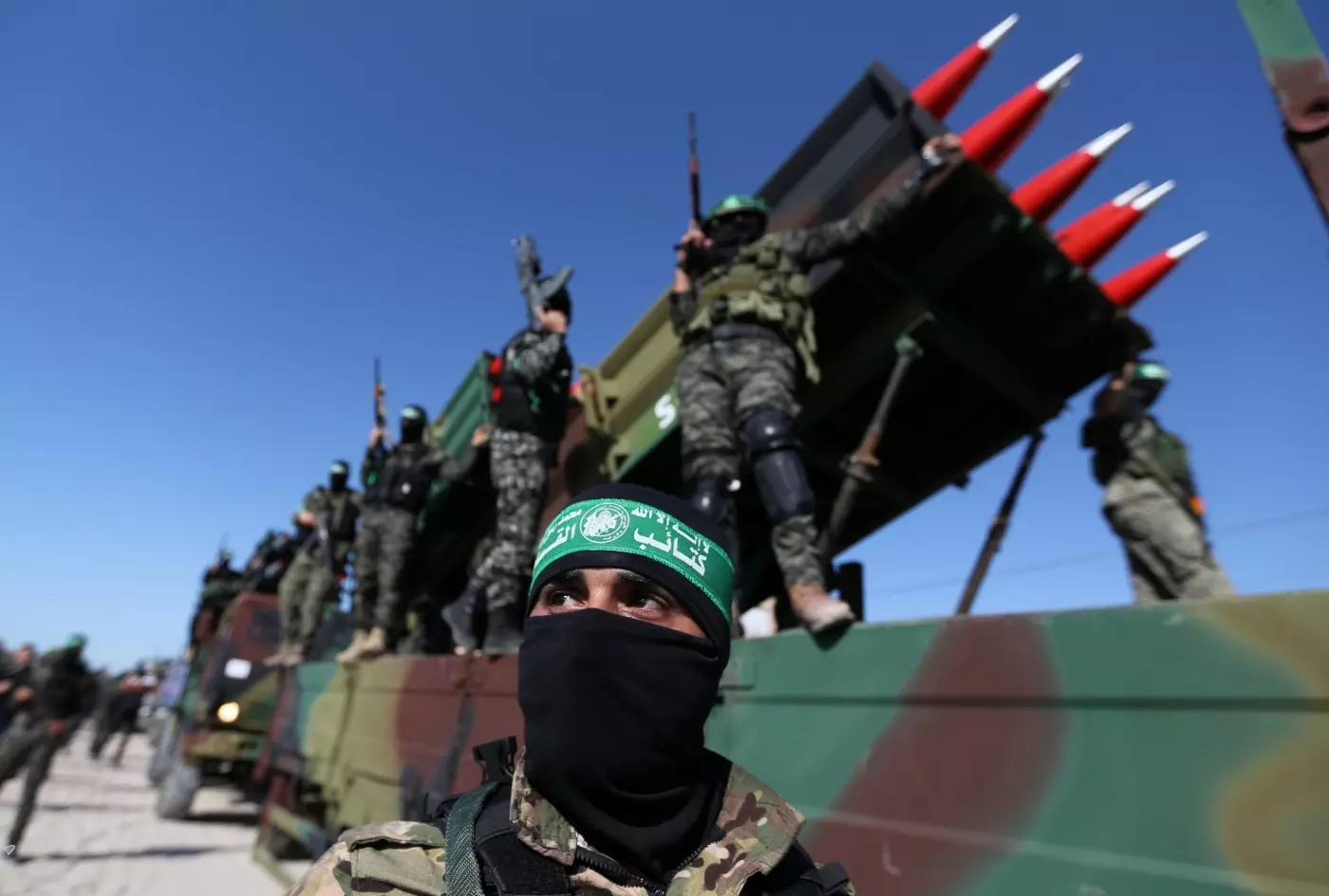
In stark contrast to the days following October 7th, the last major attack penetrating Israel’s defences, where the west were virtually begging Israel to wipe out Gaza with their mantras about “self-defence” and the need to “eliminate Hamas”, today all the talk is of “restraint” and “avoiding escalation.” It is one thing to conduct endless massacres against a starving population, but quite another to engage a militarily-advanced regional power in a potentially all-out war. Israel’s options are thus very limited.

Where are the Palestinians in all this? There may or may not be some practical impediments to the genocide by the damage caused to the airbase, that is hard to discern. Likewise for the Iron Dome system – have its resources been depleted enough to allow more Palestinian rockets to get through than would normally be the case? I don’t know, but I know such rockets have been falling in Israel in recent days (when usually they would be shot down). But more than that, obviously this is a huge morale boost for the Palestinian resistance and indeed the whole Palestinian population to see their enemy humbled. By highlighting Israeli weakness and impotence – and the cowardice of its allies – the psychological barrier to believing that an end to Zionist rule is possible has been delivered a deadly blow.

One other thought – where are the Russians in all this?

I consider this question based on two assumptions, or lets call them working hypotheses (and please correct me if you think they are wrong!) – 1. That Russia seeks not to bring down the twin pillars of counter-revolution in the region (Zionism and the House of Saud), but rather take over these tools of colonial control from the US and become their new patrons. 2. The Iranian attack on Israel would not have happened without Russian approval.

With this in mind, how does the Iranian attack fit into the long-term Russian goal of eliminating the US presence in the region?

Let’s look at what is likely happening now. Netanyahu is desperately trying to find a way to ‘respond’ – to ‘reestablish deterrence’ by launching a retaliatory attack on Iran that will NOT provoke the repeated, more intense, missile barrage that Iran has promised should this happen.

Who can help him achieve that? Who has influence enough over Iran to be able to restrain their response to any retaliation? Certainly not the US.

If I was Putin, this is what I would be telling Netanyahu: ‘Look at your ‘allies.’ They are pathetic. They can’t defend you. And now they are telling you you are not even allowed to defend yourself.

We understand Israel. We are also under attack, from Islamist terrorists, and from upstart neighbouring states, just like you. We are also misunderstood and demonised by the west. The west just wants to tie your hands with namby-pamby liberal human rights guff. None of them have experienced war, and none of them knows how to win one.

Work with us. If you want to retaliate we can find a way. We can ensure the Iranian response is limited. Can the US do this for you? They can’t help you at all. Only we can protect you from Iran’

And in this way, the Russians can slowly start to eclipse the US in the region – but much more powerfully, as patron of BOTH Israel AND Iran. And thereby create a ‘peace’ between them both – and which they both want – which the US cannot do. in fact, the US has limited power over either – its unconditional support for Israel means it has given up its leverage there, whilst its ongoing economic war with Iran means it has no leverage there either.

Finally, what was the Israeli intent in bombing the Iranian consulate in Damascus two weeks ago?

I think there are some comparisons to be drawn here with the Turkish shooting down of a Russian fighter jet on the Syrian border in 2015.

My analysis of this at the time was that it was primarily a test of the West’s willingness to confront Russia. Turkey understood that it was being used by the west as a proxy against Russia in Syria, to weaken Russia by supporting Russia’s enemies there. But it wanted to know that, if push came to shove, would the US have Turkey’s back? If things spiralled, and Turkey actually came face-to-face with Russia in war, would the US stand with them? Or would they leave them to deal with it by themselves?

The answer was – no, the US were happy to use Turkey against Russia, but was not willing to back them militarily against Russia if it came to a direct confrontation.

This led Turkey to very quickly reach a rapprochement with Russia.

Israel, in its attack on the Iranian consulate was perhaps doing the same thing. By provoking a direct confrontation with Iran, it wanted to test its ‘allies’ willingness to actually back them in such a fight. The US has been pouring scorn on Iran for decades – but would it actually be willing to take them on in a direct confrontation with Israel? The answer, again, seems to be – don’t bank on it. Hence, again, Israel may well be drawing the conclusion that it would be better to reach accommodation with them, and their Russian backers, than to rely on the US ‘having their back’ should things escalate.

The outcome Russia and Israel now likely seek would be such an accommodation – basically, Iran’s own version of the Abraham Accords, with the Russians as guarantors. I would hope Iran is not also seeking this outcome, but I wouldn’t bet on it. This would, of course, be the absolute worst outcome for the Palestinians. But history has many examples of these big confrontations being, not steps on the road to victory, but the opening salvos of a coming collaboration. In hindsight, after all, was the Yom Kippur war not merely the prelude to Camp David?

Am I being too cynical here?

I certainly hope so. But that’s how I see it.