My commentary on the news that Turkey is pulling 40 soldiers out of a NATO exercise in Norway after Erdogan’s name appeared in a list of enemies on a poster at the drill. Erdogan said an “enemy poster”, featuring his name on one side and a picture of modern Turkey’s founder, Mustafa Kemal Ataturk, on the other, was unfurled at the training exercise in Norway, prompting a decision by Turkey’s military chief and European Union minister to pull the troops out.
Author Archives: G
Close down Gibraltar
This article was originally published in April 2017 on RT.com

What’s more, this is all likely to get a lot worse unless action is taken. At present, Gibraltar is – at least in theory – bound by EU regulations on financial transparency. Once it leaves the EU, however, none of those will apply. This is why Spain, in particular, is so worried about Gibraltar being used to destroy its tax base even further. As Richard Murphy of Tax Research UK has pointed out, Gibraltar “is funded by its activity as a tax haven and centre for offshore gambling. The first activity is intent on undermining the global economy and the legitimate tax revenues of democratically elected governments. The other is wedded to destroying individual lives. Quite emphatically, this is a place that is dedicated to undermining wellbeing”. It is time it was closed down.
Britain is the heart and soul of tax evasion
This article was originally published in April 2016 on RT.com

The British government’s claim to be tackling tax avoidance is about as credible as Al Capone claiming to be leading the fight against organized crime. In fact, Britain is at the heart of the global tax haven network, and continues to lead the fight against its regulation.
The 11 and a half million leaked documents from Panamanian law firm Mossack Fonseca have proven, once again, what we have already known for some time – that the ‘offshore world’ of tax havens is a den of money laundering and tax evasion right at the heart of the global financial system.
Despite attempts by Western media to twist the revelations into a story about the ‘corruption’ of official enemies – North Korea, Syria, China and, of course, Putin, who is not even mentioned in the documents – the real story is the British government’s assiduous cultivation of the offshore world. For whilst corruption exists in every country, what enables that corruption to flourish and become institutionalized is the network of secretive financial regimes that allow the world’s biggest criminals and fraudsters to escape taxation, regulation and oversight of their activities. And this network is a conscious creation of the British state.
You wouldn’t know this, of course, listening to the words of the British Prime Minister, who always casts himself on the side of the angels. In 2013, David Cameron hosted a G8 Summit claiming that he would lead a push for an end to the use of tax havens as a means for what he called “shady secretive companies” to hide their cash and activities. In the event, nothing of any substance was agreed, largely due to Cameron’s failure to conduct the necessary behind-the-scenes lobbying: the posturing, it seems, was designed solely for public consumption.
Even today, in response to the Panama Papers, Number Ten continue to claim that Cameron put tax evasion “front and centre” of Britain’s G8 presidency and is now “ahead of the pack” on tax transparency.” Keen to hype up what will no doubt be another round of empty rhetoric and BRICS-bashing, Foreign Secretary Philip Hammond has also chimed in: “We’ve got an anti-corruption summit here in May. This is a key agenda for the Prime Minister”.
What the Panama Papers demonstrate, however, is that the real, and hidden, key agenda for the British government is maintaining the offshore netherworld’s role as a conduit through which global funds, largely plundered from the global South, can escape democratic control to enter the City of London’s private banks.
Of the 215,000 companies identified in the Mossack Fonseca documents, over half were incorporated in the British Virgin Islands, one single territory in what tax haven expert Nicholas Shaxson calls a “spider’s web” of well over a dozen separate UK-controlled dens of financial chicanery. In addition, the UK was ranked number two of those jurisdictions where the banks, law firms and other middlemen associated with the Panama Papers operate, only topped by Hong Kong, whose institutional environment is itself a creation of the UK. And of the ten banks who most frequently asked Mossack Fonseca to set up paper companies to hide their client’s finances, four were British: HSBC, Coutts, Rothschild and UBS. HSBC, recently fined $1.9bn for laundering the money of Mexico’s most violent drug cartels, used the Panamanian firm to create 2300 offshore companies, whilst Coutts – the family bank of the Windsors – set up just under 500. And, of course, David Cameron’s own father was named in the papers, having “helped create and develop” Blairmore Holdings, worth $20million, from its inception in 1982 til his death in 2010. Blairmore, in which Cameron junior was also a shareholder, was registered in the Bahamas, and was specifically advertised to investors as a means of avoiding UK tax. The Daily Mail noted that: “Even though he lived in London, the Prime Minister’s father would leave the country and fly to Switzerland or the Bahamas for board meetings of Blairmore Holdings – to ensure it would not have to pay UK income tax or corporation tax. He hired a small army of Bahamas residents, including a part-time bishop, to sign its paperwork – as part of another bid to show his firm was not British-based.”
That Britain should emerge as central to this scandal is no surprise. For as Nicholas Shaxson, a leading authority on tax havens, put it when I interviewed him in 2011, “The City of London is effectively the grand-daddy of the global offshore system”. Whilst there are various different lists of tax havens in existence, depending on how exactly they are defined, on any one of them explains Shaxson, “you will see that about half of the tax havens on there, of the ones that matter, are in some way British or partly British.” These are essentially of three types. Firstly, are “Jersey, Guernsey and the Isle of Man: the crown dependencies. They’re very fundamentally controlled by Britain.” Next are the Overseas Territories, such as the Caymans, Bermuda, the Virgin Islands, Gibraltar and the Turks and Caicos Islands, in which “all the things that matter are effectively controlled by Great Britain”. Of course, it suits the British government to portray all these territories as ‘autonomous’ or ‘self-governing’ in order to provide itself with plausible deniability about what they are doing. But the reality is that the overseas territories are run by a governor appointed by the Queen on the British government’s advice. The governor, not the elected council, Shaxson notes in his book Treasure Islands, “is responsible for defence, internal security and foreign relations; he appoints the police commissioner, the complaints commissioner, auditor general, attorney general, the judiciary and a number of other senior public officials. The final appeal court is the Privy Council in London”. Casey Gill, one of the earliest lawyers specializing in offshore operations explained how legislation was devised in the Caymans: tax experts and accountants would fly in from all over the world “and say ‘these are the loopholes in our system’. And Caymans legislation would be designed accordingly”, often by a conglomerate run by Gill, before being sent to the British Foreign Office for approval. Shaxson asked Gill if Britain, who had the power to veto such legislation, ever raised any objections. “No,” he said, “Not ever. Never”.
Finally, “there are other countries that are either in the British Commonwealth or they have very long and deep historical links with Britain. All of these different networks feed money and feed the business of handling money into the City of London. And so the City is the biggest protector – the City of London Corporation but also the banks located in the City – huge defenders of the tax havens around the world.” Recently, the City of London Corporation has been negotiating with the Kenyan government on plans<http://africanarguments.org/2015/12/01/campaigners-warn-of-kenyas-secretive-plan-to-set-up-international-financial-centre/> to create an ‘International Financial Centre’ in Kenya, which will effectively turn Kenya into the first tax haven in mainland Africa.
The entire UK-controlled web is home to offshore deposits estimated in 2009 to be worth $3.2trillion, 55% of the global total: equivalent to roughly $500 for every man, woman and child on the planet.
In his book ‘Treasure Islands: Tax Havens and the Men Who Stole the World’. Shaxson describes how, in the 1960s, a “London-centred web of half-British territories” was “deliberately created” in order to “catch financial business from nearby jurisdictions by offering lightly taxed, lightly regulated and secretive bolt holes for money. Criminal and other money could be handled by the City of London, yet far enough from London to minimize any stink”.
Whilst ostensibly involved in a process of ‘decolonisation’, in fact the UK hung on to a large global network of small, sparsely-populated islands; “the British empire”, Shaxson wrote, “had faked its own death”. These islands were to serve the same imperial purpose the empire had always had: the projection of British power and the channeling of African, Asian and Latin American wealth into Britain. But whilst some of the islands, such as Diego Garcia and the Falklands, were to serve as crucial military outposts, many of the others were developed as a means of facilitating the financial plunder of the former colonial world. In Shaxson’s words, the role of these tax havens is to “capture passing foreign business and channel it to London just as a spider’s web catches insects” whilst also acting as a “money laundering filter that lets the City get involved in dirty business while providing it with enough distance to maintain plausible deniability”. Whilst the vast majority of critical media reporting on tax havens tends to portray the UK as a ‘victim’ of tax havens, the reality is that, just like the empire they replaced, these ‘treasure islands’ provide a massive cash injection into the ‘motherland’: “in the second quarter of 2009”, Shaxson writes, “the UK received net financing of US$332.5billion just from its three Crown Dependencies Jersey, Guernsey and the Isle of Man”. And where does this money come from? Obviously, it comes from all over the world; but wealthy European and North American nations have been much better equipped to prevent ‘capital flight’ from their territories than have developing countries. Indeed, the Bank of England took special care, when it was establishing the global tax haven network, to protect the UK from potential ill effects; a letter from the Bank of England quoted by Shaxson, written in 1969 and marked ‘secret’, writes of the new tax havens that “there is of course no objection to their providing bolt holes for non-residents but we need to be sure that in so doing opportunities are not created for the transfer of UK capital to the non-Sterling area outside UK rules”. As Shaxson comments, “No objection to the looting of other countries – so long as Britain was protected”. Of course, it is the poorest countries which are in the worst equipped to defend themselves against this looting.
In 2008, Global Financial Integrity estimated that flows of illicit money out of developing countries into tax havens were running at about $1.25 trillion per year, roughly ten times the total value of aid given to developing countries by the rich world. Shaxson himself originally came to be interested in tax havens whilst investigating the illegal West African oil trade. As he explains: “I began to see how the terrible human cost of poverty and inequality in Africa connected with the apparently impersonal world of accounting regulations and tax exemptions. Africa’s supposedly natural or inevitable disasters all had one thing in common: the movement of money out of Africa and into Europe and the United States, assisted by tax havens and a pinstriped army of respectable bankers, lawyers and accountants. But almost nobody wanted to look beyond Africa at the system that made this possible”. People, like Cameron, were more interested in handwringing about ‘corrupt African governments’ than in examining the system that enabled and promoted this corruption. Tax havens are facilitating the plunder, by the London banks, of African wealth. And they are doing so because this is what they were designed to do – to continue the extortion of colonialism, just at the moment Britain was forced to give up the bulk of its formal empire.
It is this system that Cameron’s government – in diametric opposition to its rhetorical flourishes – is working to perpetuate. Indeed, much of Cameron’s battling with Europe has been driven precisely by the desire to maintain the impunity of the City and its web of tax havens in the face of attempts by the EU to regulate the banking sector. As the FT reported this week, “David Cameron personally intervened in 2013 to weaken an EU drive to reveal the beneficiaries of trusts, creating a possible loophole that other European nations warned could be exploited by tax evaders”. Britain has also led opposition to EU attempts to reforms that would make corporations register for tax in the places where they actually do business. And one of the key concessions Cameron managed to wring out of the EU Summit in February this year was that Britain, in the words of the Telegraph, “can now pull an emergency lever over eurozone laws they have “reasoned opposition” to, forcing leaders to hold back from implementation until their concerns are addressed”. The Telegraph then gives some revealing detail on exactly what kinds of laws might trigger Britain’s ‘reasoned opposition’: “The protections will address real concerns in the Treasury that the EU will develop a sprawling framework which will clamp down on the reckless “Anglo-Saxon” lenders which many on the continent still blame for bringing crisis to European shores back in 2009…In the aftermath of the last financial crisis, the UK had its fingers burnt over the EU’s decision to press ahead with a controversial banker bonus cap in 2012. …Other British battlegrounds include the much-resented Financial Transactions Tax, a radical attempt to impose a single levy on Europe’s financial sector. This was initially vetoed by the UK at the EU level, but is still being pursued by a group of euro states.” In other words, far from being hamstrung from taking action by the non-cooperation of other countries, the UK is the leading saboteur of any attempts to make the financial sector more accountable.
But of course, this is only natural. For accountability would bring the whole criminal enterprise crashing down.
The ‘spider’s web’: Britain’s global money laundering network
This article was originally published in Counterpunch magazine in June 2016

Yemen’s peace talks failed because the aggressors wanted them to fail

This article was originally published in June 2015 in Middle East Eye.
The Yemen peace talks in Geneva broke down last week before they even got underway – indeed, the delegations never even made it into the same room, let alone reaching an agreement. That this was so came as no great surprise either to observers or participants of the disastrous war in Yemen. But in all the talk of ‘mutual recriminations’ and ‘intransigence on both sides’, it is important not to lose sight of the fact that these talks failed because the aggressors – that is, the Saudi-led and British-US sponsored ‘coalition’ bombing the country – wanted them to fail.
The central fact is that the ceasefire proposed by UN Secretary-general Ban-Ki Moon – a basic condition for peace talks everywhere – was blocked by the Saudis. The Houthis, naturally enough, refused to negotiate whilst the Saudis were still bombing. The Saudis refused to stop bombing until the Houthis withdrew from all the cities they captured during the war. In other words, whilst the Houthis sought a mutual ceasefire, the Saudis demanded nothing less than abject surrender as the precondition for negotiations. Given that the Houthis have suffered very few territorial losses since the Saudis began bombing in March, this was obviously never going to happen.
The Saudis’ Yemeni allies – forces loyal to exiled President Hadi (who came to power in 2012 following an election in which he was the sole candidate) – clearly shared their backers’ bad faith in relation to the talks. As Medhat al-Zahedwrites in Al Ahram Weekly:
“In response to Ki-moon’s appeal for a two-week humanitarian truce on the occasion of the Holy Month of Ramadan, the Yemeni government in exile adopted a far from conciliatory tone. Ramadan was a month for jihad and did not require the fighting to stop, the foreign minister said …Opposition to a truce was stronger still from Ahmed Al-Masiri, the leader of the Southern Resistance forces that are fighting the Houthis and regiments from the Yemeni army loyal to former president Ali Abdullah Saleh on the ground… He rejected the idea of a humanitarian truce, saying it was “out of the question during Ramadan and after Ramadan”. “Ramadan is a holy month in which jihad is permissible,” he said…The conference got off to a heated start, with the Yemeni delegation brandishing Riyadh-inspired slogans. “We came to speak about implementing the UN Security Council Resolution, not to negotiate,” it said. “The task is to reinstate the government and withdraw the militias.” The rigidity of the Yemeni government and its Saudi backer stems from the fact that they have opposed the negotiations from the outset. They have insisted on the term “consultation” and originally pushed for Riyadh as the venue. “We agreed [to come to Geneva] to please the UN, so that they don’t say we are against peace or that we are stubborn,” Al-Masiri said.”
The anti-Houthi side, in other words, had no intention of either negotiating or accepting a ceasefire themselves, but went to Geneva simply to allow the ongoing war to be spun in such a way that places the blame solely on the Houthis.
In fact, this deliberate scuppering of any chance of a negotiated settlement in favour of continued war and chaos mirrors precisely the start of the Saudi bombing campaign itself. A month after the bombing began, it was revealed that “Operation Decisive Storm” had been initiated just as Yemen’s warring parties were on the verge of signing a power-sharing agreement that could have ended the country’s civil war. As Jamestown Foundation noted: “According to the former UN Special Adviser on Yemen, Jamal Benomar, negotiations between all major stakeholders in Yemen were nearing an interim conclusion on a power sharing agreement when Saudi Arabia and its allies launched Operation Decisive Storm on March 25 (Wall Street Journal, April 26). Despite the Houthis’ push into south Yemen, representatives from the south remained engaged in negotiations. The commencement of aerial strikes by Saudi Arabia and its partners ended the negotiations and led to a dramatic escalation of violence between the Houthis and southern militias, who, with the support of Saudi Arabia, were determined to reverse the gains made in the south by the Houthis and their allies.”
The question, then, is ‘why’? Why would Saudi Arabia gratuitously extend a destabilising war on their own Southern border – and continue to do so even when it had become thoroughly apparent that their ‘Decisive’ Storm was anything but?
The answer is not simply that they want to prevent ‘Shia’ influence in Yemen’s government, as is often claimed – as if it is self-evident that a ‘Sunni’ government would be against a ‘Shia’ one. This analysis is typical of the way in which orientalist Western journalism continues to attempt to ‘naturalise’ and reify religious and ethnic divisions in a way that suggests that sectarian intolerance is somehow in the DNA of non-Europeans. In fact, the ‘Sunni’ Saudi rulers have happily supported a Yemeni ‘Shia’ movement in the past – the forerunners of the Houthis no less – in the 1960s when the Zaydi Shia royalty was under threat from an Egyptian-backed republican movement: a conflict in which the Sunni Saudis and Shia Iran were on the same side. The Saudi involvement in Yemen is not about some kind of age-old sectarian identity – it is about strategy, a specific strategy that is in fact very new, dating back to the middle of the last decade, when the Saudi-Israeli-US-British alliance decided to channel billions of dollars into sectarian death squads that would be unleashed against the growing resistance axis spearheaded by Iran, Syria, and Hezbollah. The Houthis, by threatening the regional base of one of the most powerful of these groups – Al Qaeda in the Arab Peninsula – were a threat to this strategy. The chaos arising from the Saudi intervention, meanwhile, has provided the perfect conditions for its spread.
Yemen and Britain’s deep-seated culture of duplicity and lying

This piece was originally published in August 2017 in Middle East Eye.
Last Thursday was the last day of the current UK parliamentary session, before its summer recess. This made it the date for a particularly obnoxious new British tradition called ‘take out the trash day’. The UK government is obliged to issue all its public reports before the end of the parliamentary year; but to avoid scrutiny from MPs, the government now regularly withholds any potentially embarrassing reports until the very last day of that session. Then it can release them safe in the knowledge that there will be no time left for MPs to examine them, and no opportunity to question ministers over them.
So having issued very little information over the preceding weeks, once MPs were heading back to their constituencies, the government took the opportunity to releasedozens of reports and ministerial statements detailing everything from cuts to police, to the revolving door between cabinet ministers and private corporations, to the millions in legal fees the government spent attempting to prevent parliamentary scrutiny of Brexit. Buried deep amongst them was a Foreign Office report on the state of human rights in 30 countries deemed to be of ‘priority concern’. What makes the report embarrassing to Britain, however, is that 20 of these countries are major customers of British arms exports; with Saudi Arabia, of course, topping the list. The Saudis, whose mass executions, public lashings and restrictions on women’s rights are all detailed in the report, increased their UK weapons purchases from Britain by 11,000% following the start of their bombing campaign against Yemen in March 2015, and have purchased more than £3.3billion worth since then. Those weapons have played a major role in pushing Yemen to its current catastrophic situation, facing the fastest-growing cholera epidemic since records began, with 7 million people on the verge of famine. No wonder the UK does not want to draw attention to what is being facilitated by its relationship with the Saudis. It is right to be ashamed.
As well as downplaying Saudi atrocities, however, we also learned last Thursday that the UK government has been exaggerating its aid contribution to Yemen. In the most recent Commons debate on Yemen on 5th July, International Development minister Rory Stewart gave a figure he had inflated by 30%; his department used ‘take out the trash day’ to issue a correction to that figure, presumably expecting that no one would notice. In that, they seem to have been correct; I have been unable to find a single press report mentioning it. But perhaps lying to parliament about Yemen no longer qualifies as news – after all, it seems to have become standard practice for ministers.
By early 2016, with atrocities mounting in Yemen – such as airstrikes against three Medicins Sans Frontiers hospitals in as many months – some MPs began challenging the government’s policy, concerned in particular that British weapons were being used to carry out war crimes. Every time he was questioned on the issue, however, then-UK Foreign Secretary Phillip Hammond insisted, in the face of copious evidence, that “we have assessed there has not been a breach of international humanitarian law by the coalition”. This claim, or variations of it, was repeated by ministers to parliament six times. But then, on ‘take out the trash day’ 2016, the Foreign Office effectively admitted that it had been a lie. What Hammond should have said, said the FCO in the six ‘corrections’ they issued, was that “we have not assessed that there has been a breach of international humanitarian law by the coalition”. And that was because such an assessment – an assessment the government had been claiming all year to have carried out and which exonerated the Saudis – had never been made.
Britain is up to its neck in Yemen: it is the major supplier of the bombs dropped on Yemen, and of the jets used to drop them; it provides diplomatic cover to the Saudis (such as repeatedly blocking an independent investigation into Saudi war crimes); it supports the starvation blockade of the country; it provides training and logistical assistance to the Saudi armed forces; and it has 125 soldiers stationed in Saudi Arabia, including six officers based in the Saudi command and control HQ‘assisting with target selection’. Indeed, Britain may well have officers embedded in the Saudi army itself, given 2015’s ‘take out the trash day’ admission that Britain has 177 military personnel embedded within the armed forces of several other, undisclosed, countries. Yet ministers continue to lie to parliament that Britain is ‘not a party’ to the war in Yemen. As Mark Curtis has noted, this line was even repeated on the very day the British government disclosed that the Saudis used five different types of British bombs and missiles on Yemen.
The brazenness of the UK’s lies about its role in Yemen is underpinned by a tight secrecy which it hopes will prevent most of its duplicity ever being discovered.
Britain’s relations with Saudi Arabia have always been kept as obscure as possible, with the government regularly suppressing its own investigations and reports into the matter; the current refusal to release a Home Office report on terrorism funding lest it embarrass the Saudi and British governments has many precedents. In 2006, Tony Blair personally shut down the Serious Fraud Office investigation into a billion-pound bribery case involving British Aerospace and a Saudi prince, on the grounds it could endanger ‘national security’. And in 2014 Theresa May signed a secret ‘memorandum of understanding’ with Saudi Crown Prince Mohamed bin Nayaf which the UK has consistently refused to make public. This was just months before the British-Saudi war on Yemen was unleashed.
Secrecy surrounds every aspect of Britain’s Yemen operation. It was the Saudi foreign minister, not the UK, who admitted to the stationing of British officers in his country’s command and control centre. The government has refused to provide details of its export licences to Saudi Arabia. And the government informed neither public nor parliament of its decision to send the Royal Navy’s most advanced warship, HMS Daring, to the coast of Yemen last November, essentially to help shore up the blockade.
When the truth does come out, government ministers see it as their job to try to rubbish it; Middle East minister Tobias Ellwood, for example, responded to a UN report documenting more than 100 coalition airstrikes which violated international law by claiming they had been either “mistakes” by the Saudis or, astoundingly, that they had been “fabricated” by the “media-savvy” Houthis.
But, as Ian Cobain has thoroughly documented in “The History Thieves: Secrets, lies and the shaping of a modern nation”, this culture of secrecy and deception is deeply-rooted in British political life – and nowhere more to than the Foreign Office.
In 2001, a group of elderly Kenyans began the process of taking the British government to court over their treatment. All of them alleged that they had been tortured by the British during the Mau-Mau rebellion of the 1950s. Writes Ian Cobain, “If the old people were telling the truth, hundreds of thousands of Kikuyu, the country’s largest ethnic group, had been incarcerated by the colonial government, abused, tortured, and not infrequently raped… [Jailers] had beaten inmates to death, and even burned men alive”. Yet the official documentation in Kenya seemed to be almost entirely lacking in anything covering the treatment of prisoners – and when the judge in the trial ordered the Foreign Office to disclose all relevants, they claimed they had nothing other than what was already held in the Kenyan archives. This was strange, as the colonial authorities had been meticulous record-keepers. Someone, it seemed, was not telling the truth.
Stories had long circulated of huge wooden crates being removed from the Kenyan archives to be flown to Gatwick nine days before independence. And then, during the trial, Oxford historian David Anderson introduced a 40-year old Foreign Office minute which suggested the Foreign Office were withholding around 1500 files on Kenyan which had never been disclosed. That was when the Foreign Office came clean. They had lied about not holding any relevant files; in fact, they finally admitted, they were indeed holding 1500 files on the last days of British rule in Kenya. Once these were handed over, they immediately corroborated all the Kenyans’ allegations; as Cobain wrote, the files “detailed the way in which suspected insurgents had been beaten to death, burned alive, raped, castrated – like two of the High Court claimants – and kept in manacles for years. Even children had been killed.” The government settled the case and paid £20million compensation to 5,228 claimants.
The case had led to the discovery of an epic cover-up. For it soon emerged that it was not only Kenya from where documents had been secretly removed. Following a instruction issued by the British colonial secretary Iain Macleod on 3rd May 1961, a massive operation of file-destroying and removal had been initiated across the entire British Empire. All files that could potentially embarrass the British government were ordered to be destroyed or removed to London – and almost 9000 such files, the government admitted in 2011, from 37 former colonies, were still being secretly held in Hanslope Park, 40 miles North of London. The government said it would clear the files for declassification and transfer to the national archives, and appointed Cambridge historian Tony Badger to oversee the process. He established that the true number of secret files was in fact more than 20,000. Yet even these ‘purged’ files had clearly themselves been purged. The Yemen files were particularly thin on the ground: Aden, which had seen a four-year long rebellion repressed with vicious brutality immediately prior to independence, had just five boxes. And when these were opened, writes Cobain, “it was found that half the files inside were personnel records of law ranking officials, while most of the remaining papers concerned agriculture”. This was not surprising, given what we now know from British civil servants in Aden, who have described what one called an “orgy of burning”. The files sent to London were, he wrote, “severely weeded”, such that “details of tribal affrays, secret counter-insurgency operations funded out of the coded-worded money bags…and many examples of less sensitive ‘keeni meeni’ are all gone, and are not duplicated elsewhere”. Keeni Meeni is the Swahili term for the ‘slithering of a snake’. It is an apt description for this entire episode of empire white-washing, indeed, for the whole operation of British imperialism, both then and now.
In truth, British foreign policy has always been a matter decided behind closed doors, with public and parliament informed as little as possible, and consulted even less. Cobain explains how Britain’s eleven-year war in Oman, begun in 1965, was not even publicly admitted until 1972, with ministers lying about the situation to parliament almost compulsively, and journalists barred from entering the country at all. He also notes how Britain’s unique system of media self-censorship – enforced by the infamous D notice committee – which covers almost all aspects of war reporting, today results in an estimated 80-90% of all relevant news reports being submitted to the committee before publication. This is an amazing level of government control of information about its wars, covert or otherwise. Moreover, we now know that the 20,000 secret files from ‘Operation Legacy’ were but the tip of the iceberg: the Foreign Office is, it has recently been discovered, actually holding at least 170,000, and possibly up to 1.2 million secret files, dating back to 1662 and taking up 15 miles of floor-to-ceiling shelving. The Foreign Office has clearly never considered itself to be bound by the various Public Records Acts which supposedly make official documents accessible to all. In 1971, former Cabinet minister Richard Crossman claimed that “secretiveness is the real English disease and in particular the chronic ailment of British government” – and that it “ensures that the House of Commons is the worst informed legislature in the world”. Today’s war in Yemen shows he remains dismally right.
Discussing the US-British-Saudi war on Yemen
After Gaddafi: the West’s reconquest of Africa

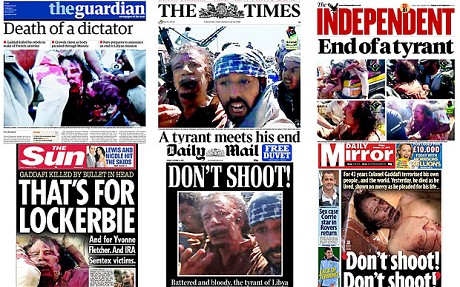
Exactly six years ago, on October 20th 2011, Colonel Muammar Gaddafi was murdered, joining a long list of African revolutionaries martyred by the West for daring to dream of continental independence. Earlier that day, Gaddafi’s hometown of Sirte had been occupied by Western-backed militias, following a month-long battle during which NATO and their ‘rebel’ allies pounded the city’s hospitals and residents with artillery, cut off its water and electricity, and publicly proclaimed their desire to ‘starve [the city] into submission’. The last defenders of the city, including Gaddafi, fled Sirte that morning, but their convoy was tracked and strafed by NATO jets, killing 95 people. Gaddafi escaped the wreckage but was captured shortly afterwards. I will spare you the gruesome details, which the Western media gloatingly broadcast across the world as a triumphant snuff movie, suffice to say that he was tortured and eventually shot dead. We now know, if testimony from NATO’s key Libyan ally Mahmoud Jibril is to be believed, that it was a foreign agent, likely French, who delivered the fatal bullet. His death was the culmination of not only seven months of NATO aggression, but of a campaign against Gaddafi and his movement that the West had been waging for over three decades.
Yet it was also the opening salvo in a new war – a war for the military recolonisation of Africa.
The year 2009, two years before Gaddafi’s murder, was a pivotal one for US-African relations. First, because China surpassed the US as the continent’s largest trading partner; and second, because Gaddafi was elected President of the African Union. The significance of both for the decline of US influence on the continent could not be clearer. Whilst Gaddafi was spearheading attempts to unite Africa politically, committing serious amounts of Libyan oil wealth to make this dream a reality, China was quietly smashing the West’s monopoly over export markets and investment finance. Africa no longer had to go cap-in-hand to the IMF for loans, agreeing to whatever self-defeating terms were on offer, but could turn to China – or indeed Libya – for investment. And if the US threatened to cut them off from their markets, China would happily buy up whatever was on offer. Western economic domination of Africa was under threat as never before.
The response from the West, of course, was a military one. Economic dependence on the West – rapidly being shattered by Libya and China – would be replaced by a new military dependence. If African countries would no longer come begging for Western loans, export markets and investment finance, they would have to be put in a position where they would come begging for Western military aid.
To this end, AFRICOM – the US army’s new ‘African command’ – had been launched the previous year, but humiliatingly for George W Bush, not a single African country would agree to host its HQ; instead, it was forced to open shop in Stuttgart, Germany. Gaddafi had led African opposition to AFRICOM, as exasperated US diplomatic memos later revealed by wikileaks made clear. And US pleas to African leaders to embrace AFRICOM in the ‘fight against terrorism’ fell on deaf ears. After all, as Muattisim Gaddafi, head of Libyan security, had explained to Hillary Clinton in 2009, North Africa already had an effective security system in place, through the African Union’s ‘standby forces’, on the one hand, and CEN-SAD on the other. CEN-SAD was a regional security organisation of Sahel and Saharan states, with a well-functioning security system, with Libya as the lynchpin. The sophisticated Libyan-led counter-terror structure meant there was simply no need for a US military presence. The job of Western planners, then, was to create such a need.
NATO’s destruction of Libya simultaneously achieved three strategic goals for the West’s plans for military expansion in Africa. Most obviously, it removed the biggest obstacle and opponent of such expansion, Gaddafi himself. With Gaddafi gone, and with a quiescent pro-NATO puppet government in charge of Libya, there was no longer any chance that Libya would any longer act as a powerful force against Western militarism: quite the contrary – Libya’s new government was utterly dependent on such militarism, and knew it. Secondly, NATO’s aggression served to bring about a total collapse of the delicate but effective North African security system, which had been underpinned by Libya. And finally, NATO’s annihilation of the Libyan state effectively turned the country over to the region’s death squads and terror groups. These groups were then able to loot Libya’s military arsenals and set up training camps at their leisure, using these to expand operations right across the region. It is no coincidence that almost all of the recent terror attacks in North Africa – not to mention Manchester – have been either prepared in Libya or perpetrated by fighters trained in Libya. Boko Haram, Al Qaeda in the Islamic Maghreb, ISIS, Mali’s Ansar Dine, and literally dozens of others, have all greatly benefitted from the destruction of Libya. By ensuring the spread of terror groups across the region, the Western powers had magically created a demand for their military assistance which hitherto did not exist. They had literally created a protection racket for Africa. In an excellent piece of research published last year, Nick Turse notes how the increase in AFRICOM operations across the continent has correlated precisely with the rise in terror threats: it’s growth, he notes, has been accompanied by “increasing numbers of lethal terror attacks across the continent including those in Burkina Faso, Burundi, Cameroon,Central African Republic, Chad, Côte d’Ivoire, Democratic Republic of the Congo, Ethiopia, Kenya, Mali, Niger,Nigeria, Somalia, South Sudan, and Tunisia. In fact, data from the National Consortium for the Study of Terrorism and Responses to Terrorism at the University of Marylandshows that attacks have spiked over the last decade, roughly coinciding with AFRICOM’s establishment. In 2007, just before it became an independent command, there were fewer than 400 such incidents annually in sub-Saharan Africa. Last year, the number reached nearly 2,000.” By AFRICOM’s own official standards, of course, this is a demonstration of massive failure. Viewed from the perspective of the protection racket, however, it is a resounding success, with US military power smoothly reproducing the conditions for its own expansion.
This is the Africa policy Trump has now inherited. But because this policy has rarely been understood as the protection racket it really is, many commentators have, as with so many of Trump’s policies, mistakenly believed he is somehow ‘ignoring’ or ‘reversing’ the approach of his predecessors. In fact, far from abandoning this approach, Trump is escalating it with relish.
What the Trump administration is doing, as it is doing in pretty much every policy area, is stripping the previous policy of its ‘soft power’ niceties to reveal and extend the iron fist which has in fact been in the driving seat all along. Trump, with his open disdain for Africa, has effectively ended US development aid for Africa – slashing overall African aid levels by one third, and transferring responsibility for much of the rest from the Agency for International Development to the Pentagon – whilst openly tying aid to the advancement of “US national security objectives”. In other words, the US has made a strategic decision to drop the carrot in favour of the stick. Given the overwhelming superiority of Chinese development assistance, this is unsurprising. The US has decided to stop trying to compete in this area, and instead to ruthlessly and unambiguously pursue the military approach which the Bush and Obama administrations had already mapped out.
To this end, Trump has stepped up drone attacks, removing the (limited) restrictions that had been in place during the Obama era. The result has been a ramping up of civilian casualties, and consequently of the resentment and hatred which fuels militant recruitment. It is unlikely to be a coincidence, for example, that the Al Shabaab truck bombing that killed over 300 people in Mogadishu last weekend was carried out by men from a town in which had suffered a major drone attack on civilians, including women and children, in August. Indeed, a detailed study by the United Nations recently concluded that in “a majority of cases, state action appears to be the primary factor finally pushing individuals into violent extremism in Africa”. Of more than 500 former members of militant organisations interviewed for the report, 71% pointed to “government action”, including “killing of a family member or friend” or “arrest of a family member or friend” as the incident that prompted them to join a group. And so the cycle continues: drone attacks breed recruitment, which breeds further terror attacks, which leaves the states involved more dependent on US military support. Thus does the West create the demand for its own ‘products’.
It does so in another way as well. Alexander Cockburn, in his book ‘Kill Chain’, explains how the policy of ‘targeted killings’ – another Obama policy ramped up under Trump – also increases the militancy of insurgent groups. Cockburn, reporting on a discussion with US soldiers about the efficacy of targeted killings, wrote that: “When the topic of conversation came round to ways of defeating the [roadside] bombs, everyone was in agreement. ‘They would have charts up on the wall showing the insurgent cells they were facing, often with the names and pictures of the guys running them,’ Rivolo remembers. ‘When we asked about going after the high-value individuals and what effect it was having, they’d say, ‘Oh yeah, we killed that guy last month, and we’re getting more IEDs than ever.’ They all said the same thing, point blank: ‘[O]nce you knock them off, a day later you have a new guy who’s smarter, younger, more aggressive and is out for revenge.”’
Alex de Waal has noted how this is certainly true in Somalia, where, he notes,“each dead leader is followed by a more radical deputy. After a failed attempt in January 2007, the United States killed al Shabaab’s commander, Aden Hashi Farah Ayro, in a May 2008 air strike. Ayro’s successor, Ahmed Abdi Godane (alias Mukhtar Abu Zubair), was worse, affiliating the organization with al Qaeda. The United States succeeded in assassinating Godane in September 2014. In turn, Godane was succeeded by an even more determined extremist, Ahmad Omar (Abu Ubaidah).” It was presumably Omar who ordered the recent attack in Mogadishu, the worst in the country’s recent history. “If targeted killing remains a central strategy of the War on Terror”, De Waal wrote, “it is set to be an endless war.”
But endless war is the whole point. For not only does it force African countries, finally freeing themselves from dependence on the IMF, into dependence on AFRICOM; it also undermines China’s blossoming relationship with Africa.
Chinese trade and investment in Africa continues to grow apace. According to the China-Africa Research Initiative at John Hopkins University, Chinese FDI stocks in Africa have risen from just 2% of the value of US stocks in 2003 to 55% in 2015, when they totalled US$35 billion. This proportion is likely to rapidly increase, given that “Between 2009 and 2012, China’s direct investment in Africa grew at an annual rate of 20.5%, while levels of US FDI flows to Africa declined by US$8 billion in the wake of the global financial crisis”. Chinese-African trade, meanwhile, topped $100billion in 2015.
China’s signature ‘One Belt One Road’ policy – to which President Xi Jinping has pledged $124billion to create global trade routes designed to facilitate $2trillion worth of annual trade – will also help to improve African links with China. Trump’s policy towards the project was summarised by Steve Bannon, his ideological mentor and former chief strategist, in just eight words: “Let’s go screw up One Belt One Road”. The West’s deeply destabilising Africa policy – of simultaneously creating the conditions for armed groups to thrive whilst offering protection against them – goes some way towards realising this ambitious goal. Removing Gaddafi was just the first step.
This article was originally published on RT.com
A public meeting “Remembering Gaddafi, supporting the Libyan resistance” will be held in London in Housman’s bookshop, King’s Cross, on Saturday October 21st at 6.30pm. All welcome.
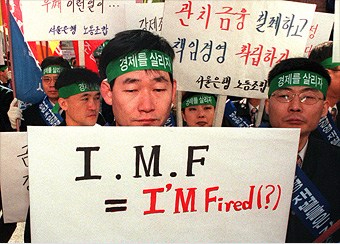
20 years after the East Asia crash: is history repeating itself?

20 years ago this month, a run on the Thai currency triggered a financial crisis that quickly devastated the economy of the entire region, sinking the currencies of Thailand, Indonesia and South Korea and ultimately spreading as far as Russia and Brazil. Far from ‘lessons being learned’, however, history looks worryingly set to repeat itself.
On 2nd July 1997, Thailand’s Prime Minister Chavalit Yongchaiyudh announced that the baht, would be freely floated. The Thai government lacked the foreign exchange reserves necessary to continue pegging the currency to the US dollar – and the result was a collapse of the baht to less than half its former value.
The contagion quickly spread to Thailand’s neighbours as panicked investors began selling off their stocks in other East Asian currencies. Within months, noted the Financial Times on the 2nd January 1998, the crisis had “laid waste to what was once the most dynamic part of the world economy”, leading to a collapse of the currencies of Indonesia, Malaysia, the Philippines, and South Korea. Later that year, the economies of Russia and Brazil were seriously hit by the impact of the crisis on commodity prices, triggering crises of their own.
Across the region, economic devastation reigned. Unable to refinance their debts, companies of all sizes had their loans called in. But the collapse of their currencies meant that the value of these debts – denominated in dollars – had increased exponentially. A wave of bankruptcies drove unemployment through the roof, whilst governments hit by declining tax revenues – and IMF-imposed austerity – were forced to cut back on social safety nets. At the same time, the collapse of currency values led to rapid inflation, forcing up prices of basic essentials such as food and fuel. Poverty rates ramped up – and in Indonesia, the resulting social unrest even led to the overthrow of the government.
What had caused this devastation? In the years preceding the crash, the economies of East Asia had, under IMF tutelage, removed capital controls. This, in turn, had led to an influx of ‘hot money’ into those economies, as low returns in the developed world prompted investors to seek capital outlets elsewhere. As the Financial Times noted in January 1998, “between 1992 and 1996 net private capital flows to Asian developing countries jumped from $21bn to $101bn. …What caused the inflow was largely the search for better returns by investors made insensitive to risk and hungry for profit by the western bull market.” Those investors had been especially encouraged by the 1993 World Bank report “The East Asian miracle” praising the growth those countries had achieved. To keep their exports competitive, they had pegged their currencies to – then undervalued – dollar. But things turned sour when the so-called ‘reverse Plaza accord’ of 1995 brought about a major appreciation of the dollar, decimating the exports of the East Asian economies. It took a while for this to ‘filter through’ to investors, but once it became clear that East Asian currencies and stocks were overvalued, the herd mentality took over. “As usual,” wrote the FT, “mania ended in panic”.
Thailand, Indonesia and South Korea were all forced to take billions of dollars in emergency loans from the IMF – coming, of course, with strict conditions, which exacerbated the crisis. As is standard with the IMF, recipient governments were forced to adopt strict austerity measures, which preventing them from doing anything to stimulate demand. But they were also forced to abolish all barriers on foreigners purchasing assets such as banks and property. As a result, Western capital was able to swoop in and buy up Asian infrastructure – some of the most modern plant and machinery in the world – for pennies on the dollar, as companies unable to meet their dollar debts were forced to sell their assets at rock-bottom prices. As Wade and Veneroso wrote, “the combination of massive devaluations, IMF-pushed financial liberalisation, and IMF-facilitated recovery may have precipitated the biggest peacetime transfer of assets from domestic to foreign owners in the past fifty years anywhere in the world”. For Professor Radhika Desai, this was “the most impressive exercise of US power the world had seen in some time”, providing, in the words of Peter Gowan, “a welcome boost for the US financial markets and through them for the US domestic economy” as “capital flows bypassed emerging-economy financial markets and went directly into the upward-moving US bond and stock markets” (Desai). Western policy had facilitated the crisis, exacerbated it, and profited immensely from it: for, as Peter Gowan has noted, “the US economy depends…upon constantly reproduced international monetary and financial turbulence” – whilst Wall St in particular “depends upon chaotic instabilities in ‘emerging market’ financial systems”.
With the western world poised to ramp up interest rates, could it be that we are again on the verge of just such an episode? The parallels are worrying.
First of all, just as during the years prior to 1997, the past decade has seen a massive influx of capital into the developing world, exacerbated by the British-US-German-Japanese ‘quantitative easing’ (QE) programmes. According to the world bank, “Over the four-year period between mid-2009 and the first quarter of 2013 [ie the first four years of the QE experiment], cumulative gross financial inflows into the developing world rose from $192 billion to $598 billion”, which, it noted, was “more than twice the pace compared to the far more modest increase of $185 billion between mid-2002 and the first quarter of 2006”. Former foreign secretary of India, Shyam Saran, warned of the potentially destabilising effects of this influx back in 2013: “According to one estimate, about 40 percent of the increase in the U.S. monetary base in the QE-1 phase leaked out in the form of increased gross capital outflows, while in the QE-2 phase, it may have been about one-third. This massive and continuing surge of capital outflows to emerging and other developing economies is having a major impact. Corporations, which have a sound credit rating, are taking on more debt, and increasing their foreign exchange exposure, attracted by low borrowing costs. Their vulnerability to future interest rate changes in the developed world and exchange rate volatility will increase.” The Daily Telegraph has also picked up on this vulnerability, noting that “Nobody knows what will happen when the spigot of cheap dollar liquidity is actually turned off. Dollar debts outside US jurisdiction have ballooned from $2 trillion to $9 trillion in fifteen years, leaving the world more dollarised and more vulnerable to Fed action than at any time since the fixed exchange system of the Gold Standard.” Even the World Bank have admitted that the reversal of QE “is a central concern for developing economies, which have struggled to cope with the surge in financial inflows that they have experienced over the past several years, and are fearful that the renormalization of high income monetary policies will be accompanied by a disorderly sudden stop in capital inflows.” Later in their study, they conclude that “These fears were not unfounded”. Just as during the pre-1997 period, emerging markets are dangerously leveraged, with the influx of ‘hot money’ into the developing world leaving it exceptionally vulnerable to any action that might reverse this flow. And such action is almost certainly on the cards.
On July 18th, the Times’ economics editor Philip Aldrick wrote that “In two months’ time, the US Federal Reserve is expected to begin the next phase in the greatest economic experiment of modern times. America’s central bank has signalled that it may start unwinding quantitative easing in September with the piecemeal sale of the $3.5trn of bonds bought since QE’s 2008 launch. No one quite knows what happens next, but the gloomiest predict another financial maelstrom. One thing is certain. Borrowing costs will rise”. Indeed, he writes, “it’s already happening. Government bond yields, used to price everything from fixed rate mortgages to corporate loans to pension schemes, have jumped. Since June, the yield on ten-year UK gilts has risen from below 1% to 1.275%. The same is happening in US and German bonds.
Against the backdrop of automatic global monetary tightening, a Fed decision to flood the market with more bonds would lift borrowing costs even higher.” In other words, we are entering an era of rising effective interest rates exactly like that which prefigured the 1997 crisis.
A second parallel is that the debts being accumulated in the global South are, again, largely denominated in dollars. In 1997, this was devastating as it meant that, as local currencies dropped in value, their dollar debts effectively escalated by the same amount; had the debts been denominated in local currency, the number of bankruptcies would not have been nearly so large. To guard against a repeat scenario, therefore, the countries hit in 1997 began to issue debt only in their own currency: those wishing to invest would have to first convert their money into the local currency, and only then could they do so. As the years passed, however, complacency seems to have set in: to such an extent that, today, according to the Bank of International Settlements, non-bank borrowers in emerging markets have now accumulated more than $3 trillion in dollar-denominated debt. According to a report published by the Bank last year, “The accumulation of debt since the global financial crisis has left EMEs [emerging market economies] particularly vulnerable to capital outflows. As private sector borrowing has led to overheating in several large EMEs, the unwinding of imbalances may generate destabilizing dynamics.” The report goes on to note that around $340 billion of developing country debt will be maturing this year, “creating a potential default risk if investors start pulling money out of emerging markets”.
All the warning signs are there. Writing for Bloomberg, Lisa Abramowicz wrote in November 2016 that “the debt of developing economies is positioned uniquely for pain.” Noting Adair Turner’s warning that “the large increase of emerging-market debt, much of it denominated in dollars,” is one of the biggest risks in the financial system right now, she added, “All that money is owed to somebody, and a failure to pay it back will cause big ripple effects. So as emerging markets come under stress, bond investors around the world should take note. As the dollar continues to strengthen, it’s not a stretch to see how this developing-market debt selloff can worsen, having far-reaching consequences on markets around the world.”
Others have specifically drawn attention to the parallels with 1997. Reporting on a speech by Bill Dudley, head of the New York Fed, the Telegraph noted that he had “hinted that the Fed may opt for the fast tightening cycle of the mid-1990s, an episode that caught markets badly off guard and led to the East Asia crisis and Russia’s default.” And the above quoted former foreign secretary of India, Shyam Saran, warned that “The Asian financial crisis of 1997/98 was, in part, triggered by an earlier version of QE pursued by Japan in the aftermath of the bursting of its property and asset bubble in the early 1990s. Then, too, the large inflow of low-cost yen loans led to the asset price bubbles, inflationary pressures and currency instability in the Asian economies.”
Of course, triggering a new crisis by ramping up interest rates and selling off bonds – precisely at a time when a large portion of developing world debts are maturing – would hurt the West as well. Yet this seems to be precisely what is being planned. Because if a new crisis is inevitable – and I believe the inherent capitalist tendency towards overproduction means it is – it makes perfect sense to time it at a moment when the global South will be forced to bear the brunt. And, even if the US it hit, so long as everyone else is hit harder, that is a net gain for US power. As the Telegraph noted, “The US is perhaps strong enough to withstand the rigours of monetary tightening. It is less clear whether others are so resilient.” And, says Abramowicz, “While bonds globally are posting some of the biggest losses on record, debt of U.S., Germany, Japan and other large economies will eventually have natural buyers that can swoop in and support values.”
Fans of Breaking Bad will remember the memorable scene in which drug lord Gus Fring arrives at the mansion of his arch rival Don Eladio with a bottle of poisoned tequila disguised as a peace offering. Eladio is suspicious, so to prove its purity, Gus drinks the first shot. Whilst the rest of the cartel are poisoning themselves, he heads to the bathroom to make himself sick. After nearly dying, he eventually recovers – whilst his rivals’ corpses lay strewn around the swimming pool. Is the US hoping to pull the same stunt – choking themselves, but fatally throttling everyone else in the process, so they can swoop in and pick up the pieces? It wouldn’t be the first time.
This article originally appeared on RT.com
The Coming War On China
Myself and Emerson Forde, curator of the African Odyssey season at the BFI, discuss John Pilger’s new film The Coming War on China